
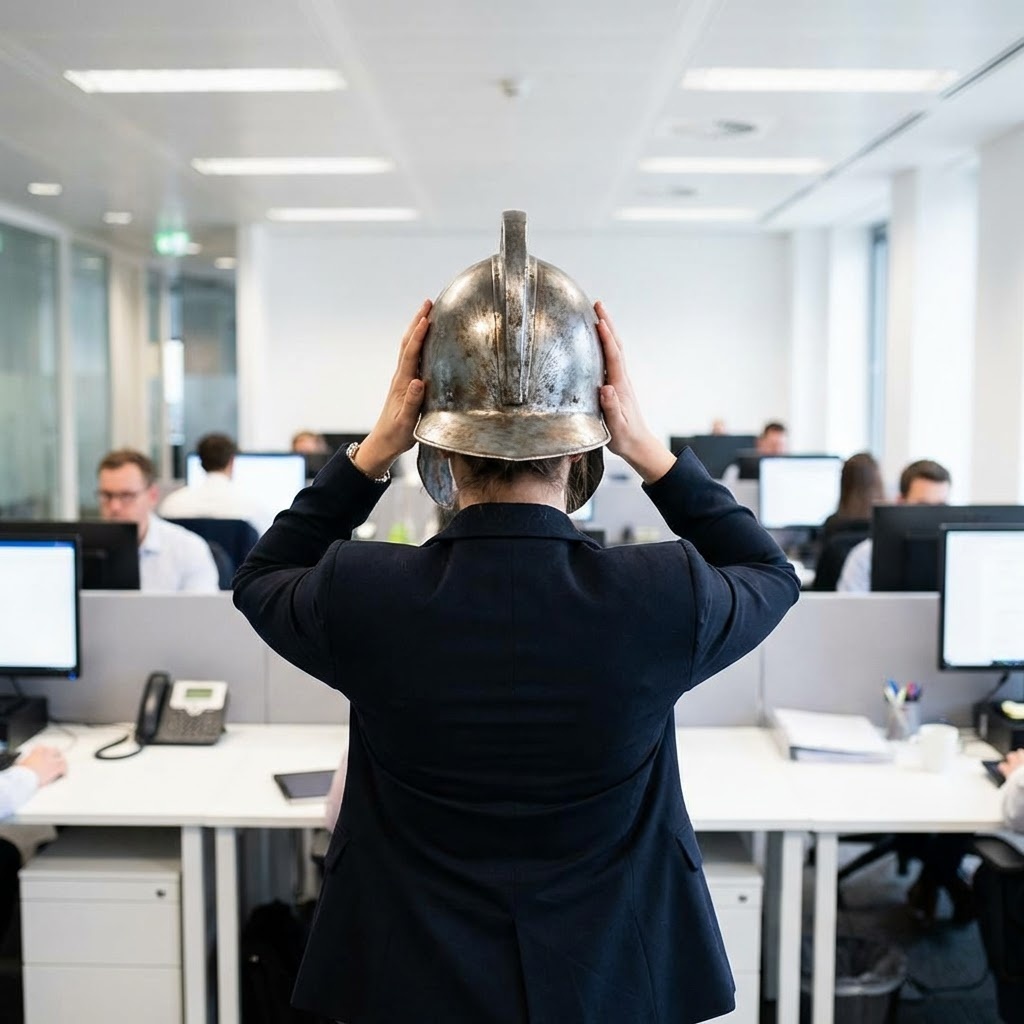
The meeting is tomorrow at ten. You start preparing at four. Not because the material is complicated. You know it through and through. But knowing the subject matter is not the same thing as being believed.
So you put in hours of prep time that others might not: you pull the numbers again, you check the source, you rephrase the opening line so it sounds confident but not combative. You spend more time than you should wondering about the difference between confident and combative; a new executive will be in the meeting — how will he perceive it? You anticipate the question Mark will ask because he always asks that question. You build a slide to head off the question, even though he’ll ask it anyway. You are not preparing your argument, you’re preparing for doubt.
This is the invisible labor of credibility. It can become a second full-time job: first you do your official work, then you do the credibility work.
Not everyone has to do this; some people come pre-believed. Research shows that men — especially white men — are often seen as credible and competent in the workplace. For those who are automatically given the benefit of the doubt, preparing for a meeting is just a change to sharpen and refine an argument. But if you don’t have that built-in authority, you’re not just presenting an idea, you are pre-answering a cross-examination.
Credibility work is all the labor you put in before you speak. It can include a variety of things:
- softening emails
- adding context so no one feels surprised
- documenting decisions in case memory shifts later
- sending follow-ups to confirm what was already clear
- adjusting your language so your certainty reads as collaboration
Credibility work doesn’t just happen at work; it’s also happening before you go to work, when you rehearse what you’re going to say. It’s that conversation you practice de-escalating in your head while you’re driving somewhere. It’s second-guessing your tone.
The thing is, no one calls this labor. It’s not recognized as work because it looks like a lot of things: diligence, your personality, caring too much, or — more harmfully — neurosis.
This is not neurosis, though. It’s adaptation, and more people than you realize are doing this in the workplace. But we don’t talk about it because admitting to it makes us seem less credible, not more credible.
Like, if you have to do this work, you’re the problem. I’d like to posit that the system that makes many of us do this is the problem, so let me tell you a story about my own credibility work, which started in middle school.
Growing up, I saw a lot of the women in my life undermined and trivialized. I was determined that this would not happen to me, so my plan — at the ripe age of 11 — was to read as many articles about career advice as I could.
Because this was in the early ‘90s, my sources were the newspaper and the glossy client magazines sent out quarterly by my parents’ insurance company. Also because this was the early ‘90s, advice for women about “getting ahead at work” was questionable.
There was a lot of emphasis on “power behaviors,” like a firm handshake, eye contact, and speaking in a low register. One piece of advice I internalized was to not trail off at the end of a sentence or lilt up, but to end sentences with a downward inflection.
I put this into practice at home and school immediately. In retrospect, it’s kind of funny. But also, it’s sad. I was a sixth grader. I should have been watching Disney Afternoon and Tiny Toons after school, not starting the credibility work for my future career.
The harm of credibility labor goes beyond a few missed afternoon cartoons, however.
It’s exhausting work for those who have to do it, and it’s fraught with anxiety. The cruel irony is that this invisible labor actually does make a meeting run more smoothly. If you anticipate objections, there is less friction in the room. When you pre-answer questions, Mark doesn’t have to ask. When you over-document everything, projects stay aligned.
The system benefits from your anxiety, but doesn’t recognize it.
However, we can recognize it if we look for the signs ourselves:
- Watch who can show up half-prepared and be given grace.
- Watch who can say “This is just a thought,” and be rewarded for boldness.
- See who can correct themselves mid-sentence without it counting against them.
- Notice who arrives fully footnoted.
- See who brings three versions of the same argument.
- Notice who has rehearsed responses to objections that haven’t been voiced.
It’s important to see that invisible work, because then we can understand its effects on our colleagues and on our workplace. We know who is threadbare from overpreparation and we can see whose anxiety greases the axles of our teams.
More importantly, we can see how power is distributed at work. We like to think of authority as something that’s earned based on merit. But, for some people, it’s just awarded. For others, it’s built in private, in the quiet hours where someone decides whether they can afford to risk being underprepared.
That difference is power. Until we recognize the invisible labor of being believed, we will continue to mistake anxiety for personality and armor for ambition.

Leave a Reply
Want to join the discussion?Feel free to contribute!